
Published: Apr 14, 2026

Steam is the heart of sterilization and thermal processing. Whether you are operating a pharmaceutical autoclave or a food processing retort, the quality and consistency of your steam directly determine product safety, regulatory compliance, and operational efficiency.
In industries where sterility and shelf stability are non-negotiable, steam is not just a utility, it’s a critical process ingredient.
In pharmaceutical autoclaves and food retorts, steam is used because it transfers heat extremely efficiently. When saturated steam contacts a cooler surface, it condenses and releases a large amount of latent heat. This rapid heat transfer ensures:
Unlike dry heat or hot water, steam penetrates porous loads, packaging, and complex geometries effectively, making it ideal for sterilization.
In both gravity displacement and pre-vacuum autoclaves, as well as static or rotary retorts, air removal is critical. Steam allows:
Poor steam quality leads to air pockets, which significantly reduce sterilization effectiveness. Steam is not affected by the rotation of the case where water is deflected due to centrifugal forces.
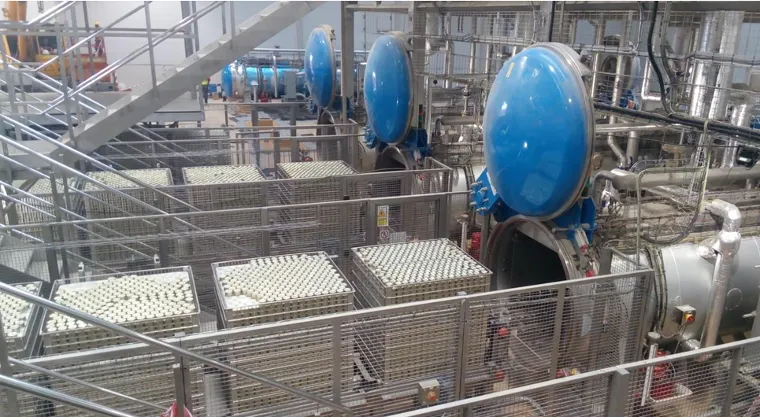
To achieve consistent and compliant sterilization results, you must carefully evaluate your steam generation system.
 Calculate your savings
Steam used in sterilization should typically have:
Wet steam causes:
Excess moisture reduces effective sterilization temperature.
Air and other non-condensable gases are the biggest enemies of sterilization.
Steam systems should minimize NCGs through:
Autoclaves and retorts rely on tightly controlled pressure-temperature relationships.
Fluctuations can cause:
Your boiler must:
For retorts, especially rotary systems, pressure stability is critical to prevent container deformation.
In pharmaceutical autoclaves:
In food retorts:
Choosing the correct steam type is essential for compliance and safety.
Suboptimal steam systems lead to:
In food processing, inadequate retort sterilization can compromise shelf stability.
In pharma, it can invalidate entire production batches.
Steam quality directly impacts both safety and profitability.
Steam is not just a utility, it is a controlled, validated process medium.
In autoclaves and retorts, steam quality determines:
If your sterilization results are inconsistent, the first place to look is not the autoclave, it’s your steam generation system.
Because when it comes to thermal processing, steam quality is product quality.





















Clayton is a global manufacturer of industrial steam solutions. European production and engineering have been carried out since 1961 in Bornem, Belgium, where Clayton of Belgium serves as the EMEA headquarters and main production hub for Europe, the Middle East, and Africa. The global headquarters of the Clayton Group is located in California, with additional production facilities in Mexico and Europe, and subsidiaries in France, Germany, the Netherlands, Spain, and the United Kingdom.

WORK SAFETY



