Contact us

Steam in snack food production

Snack production needs a series of thermal transformations: starch is gelatinized, moisture is driven off, dough is expanded and product is fried, roasted or dried. Steam is the utility that carries most of this energy, because condensing saturated steam releases its latent heat at a constant, controllable temperature and delivers it quickly and uniformly.

This page explains where steam is used in snack manufacturing, what each application requires and why the process load profile matters when choosing a steam generator.

Steam in snack food production

Steam applications in snack production

Steam enters a snack line at several points, either indirectly through jackets, coils and heat exchangers or directly by injection into the product or process stream. The route depends on the process and the available steam quality.

Not every snack heating step uses steam. Tortilla chip baking ovens are commonly gas-fired, and fryers are frequently heated by thermal oil or direct firing. Steam is chosen where indirect, controllable, clean heat is needed or where a central steam system already serves the plant.

Extrusion and preconditioning

In direct-expanded snacks, cereal and puffed products, the raw mix is normally hydrated and heated in a preconditioner before it enters the extruder. Direct steam injection raises moisture and temperature at the same time and starts starch gelatinization, so the extruder needs less mechanical energy (SME) and the screw and barrel wear less. Steam is also used in extruder barrel jackets for temperature control. Steam flow must be stable: fluctuations change the moisture and temperature entering the die and cause variations in expansion and bulk density.

Cooking of raw materials

Masa for tortilla chips is made by cooking corn in an alkaline solution (nixtamalisation), usually batch-wise in steam-heated kettles or closed vertical cookers, followed by steeping. Pulses, cereals and starch mixes for pellets and formed snacks are also cooked in jacketed vessels or by direct steam. Cooking times depend on the product, so demand follows a batch rhythm.

Peeling and blanching

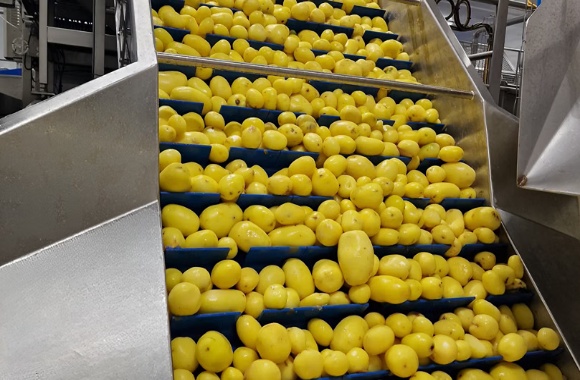
Potato chip lines commonly use steam peeling: potatoes are exposed to high-pressure steam (above 150 °C) for a few seconds and the vessel is then rapidly depressurised. Water under the skin flashes to steam, loosening the skin so brushes or sprays can remove it with little loss of flesh. Blanching and pre-heating also use steam or steam-heated water.

Frying

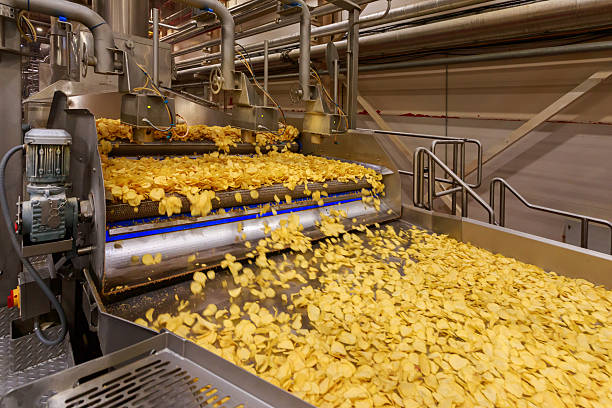
Fryers are heated by direct-fired gas, thermal oil or steam. Steam-heated fryers use an internal heat exchanger, and the oil is held at roughly 170–190 °C. Steam also heats oil storage and supply lines and keeps seasoning oil fluid.

Drying and puffing

Snack pellets, baked snacks and many extruded products are dried to a low final moisture. Steam-to-air heat exchangers supply hot, clean drying air without exposing the product to combustion gases.

Baking, roasting and pretzels

Steam is used for oven humidification, pre-heating process water, and heating pretzel alkaline baths and nut blanching and roasting equipment.

Cleaning and sanitation

Snack lines, and fryers in particular, need frequent washdown and CIP cycles. Steam heats cleaning solutions and rinse water and supplies hot water for sanitation between runs.

Chocolate, coatings and sweet snacks

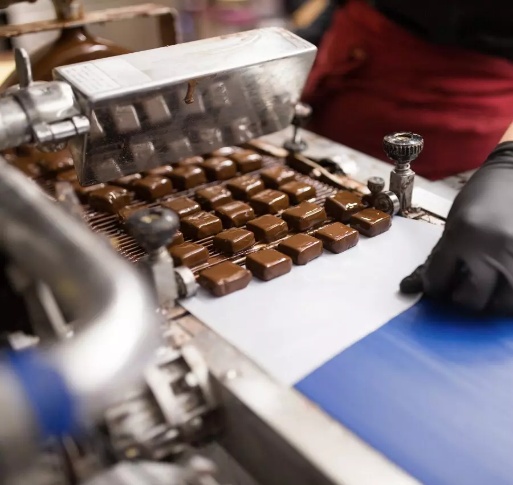
Chocolate and compound coatings for enrobed snacks, bars and clusters are melted, held and tempered in jacketed tanks, pipes and tempering machines. These are typically heated with hot water, often produced from steam through a heat exchanger, giving gentle, indirect heat without hot spots.

Syrups, caramel and binders

Cereal bars, clusters, glazed nuts, fruit snacks and gummies use cooked sugar syrups, caramel and starch or pectin slurries. These are cooked in steam-jacketed kettles or heat exchangers. The final cook temperature determines the dissolved-solids content and therefore the texture of the finished product.

Nuts, seeds and popcorn

Steam is used for blanching and pasteurizing nuts and seeds, while steam-heated air or jackets support roasting and drying.

Dairy-based and prepared desserts and snacks

Puddings, custards, cheese and dairy snacks and similar products are cooked and pasteurized in jacketed vessels or with direct steam. Holding temperature and time form part of food-safety validation.

Steam peeling of potatoes
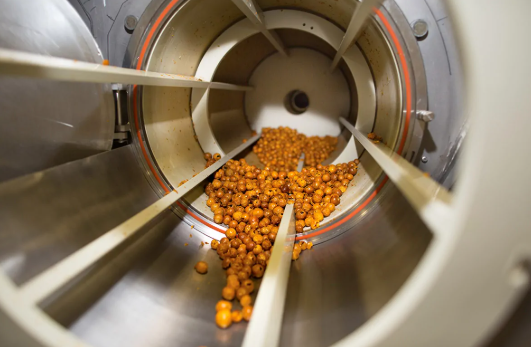
Processing nuts and seeds
Why stable temperature matters

Why stable temperature matters

In snack, confectionery and dessert production, taste, texture, color, expansion and shelf life result from temperature, time and moisture. Each must be reproduced from batch to batch. Stable process heat turns a formulation into a repeatable product.

01

Chocolate and coatings

Tempering relies on crystallizing cocoa butter in the correct form by passing through defined temperature stages. Tolerances are tight. A drifting heating medium causes bloom, poor snap and inconsistent coating thickness.
02

Syrups, caramel and binders

For sugar syrup, boiling temperature is directly linked to dissolved-solids content. The cook temperature sets final moisture and therefore chewiness or crispness. A few degrees of difference produce a different product.

03

Extruded and expanded snacks

Moisture and temperature leaving the preconditioner determine how far the starch is cooked and how the product expands at the die, and therefore its density and crunch.

04

Frying

Oil temperature affects oil uptake, color, flavor and the formation of undesirable compounds such as acrylamide, so it is held within a narrow window.

05

Drying and baking

Final moisture and water activity control crispness and microbiological stability. Both depend on stable air temperature and humidity.

06

Pasteurization and cooking

Time and temperature are validated food-safety parameters, so the heat supply must reliably reach and hold the specified value.

Steam pressure and product quality

Steam suits this precision because the temperature of saturated steam is fixed by its pressure. Stable steam pressure gives a stable heating temperature, and condensation delivers heat at that constant temperature without a gradient across the heat exchanger. A pressure swing of ±0.5 bar corresponds to about ±2 to 2.5 °C at the heating surface. Keeping pressure steady under a changing load helps keep product quality steady.

Technical requirements of the steam supply and the Clayton answer

Pressure and temperature

Saturated steam has a fixed temperature for each pressure, so operating pressure sets the maximum process temperature. Heat transfer also needs a temperature difference: steam temperature must be higher than the product or oil temperature, not equal to it.

Purity

Where steam touches the product, as in preconditioning, direct cooking and oven humidification, it is a food ingredient stream. Feedwater treatment, steam generation and distribution must meet the applicable food-safety requirements for that use. Conventional plant steam is not automatically suitable.

The Clayton answer

The Clayton answer

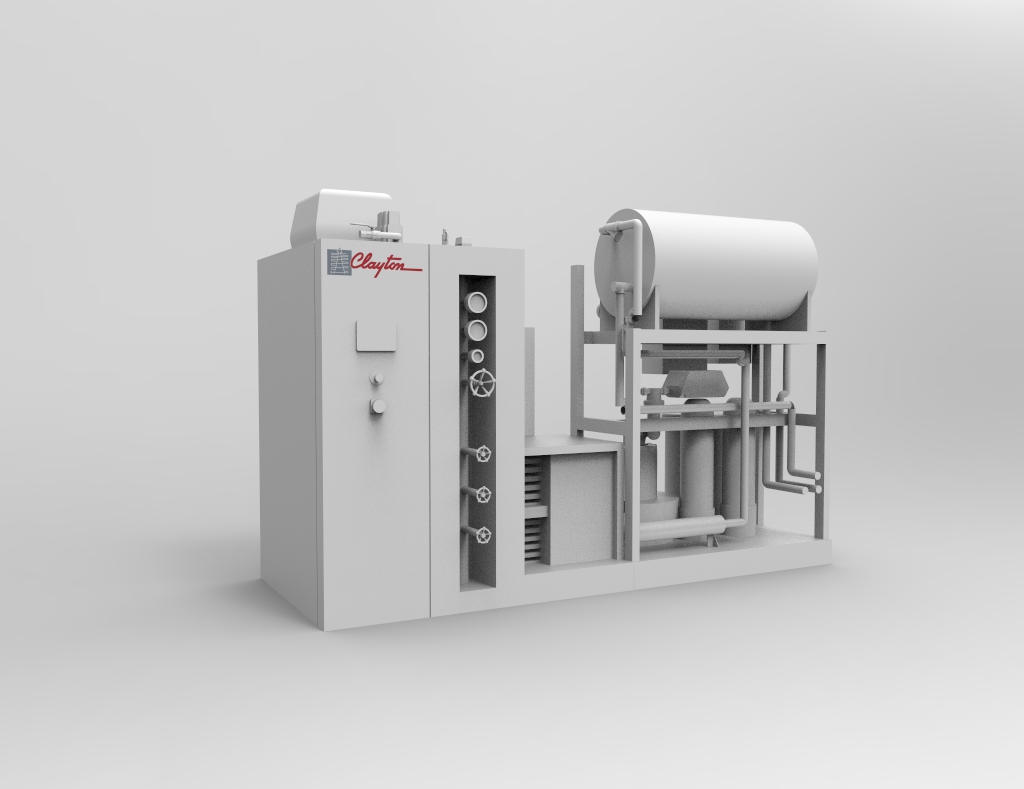
Clayton steam generators address the remaining requirements with a forced-circulation single-coil design: water is turned into steam in one pass through a spiral-wound coil, the firing rate is matched to water flow, and a fixed-vane separator removes moisture.

Response to a variable load

Snack plants rarely draw steam at a constant rate. Fryer and dryer start-up, product changeovers, batch cooking and CIP cycles create steep rises in demand, followed by long periods near base load. A steam system must cover both peak and low-load periods efficiently and recover quickly from a cold start after weekend or overnight shutdowns.\n\nA conventional shell boiler is usually sized for peak load, so it spends much of its time at part load with standby and cycling losses. Pressure can dip when demand jumps. Its large water volume takes time to reach pressure, so plants either keep it hot overnight or lose production time at the start of a shift. A Clayton generator has a small water inventory and a firing rate that follows water flow, so output follows demand and conditions remain stable, supporting repeatable recipes.

Steam quality and dryness

Almost all the useful energy in saturated steam is its latent heat. For example, a 1,200 kW dryer air heater supplied at 8 bar g needs about 2,130 kg/h of dry steam. At only 95% dryness, the same duty needs about 5% more steam. Entrained water forms a film on heat-exchange surfaces, loads steam traps and can cause water hammer. In direct injection, wet steam adds uncontrolled moisture to the preconditioner and extruder feed.\n\nIn a conventional boiler, carry-over during load swings upsets direct injection and fouls heat exchangers, causing product variation. Clayton quotes steam quality above 99%, with less than 1% moisture.

Conclusion

In a snack plant, steam quality and response time show up in the product: moisture entering the extruder, fryer oil temperature and dryer air temperature all depend on them. Because demand is cyclical, the right generator is efficient at part load, starts fast and delivers dry steam when the load changes, rather than simply having the largest nameplate output. Clayton’s coil-based steam generators are designed around those requirements.

Need steam for snack production?

Tell us about your process, steam demand and product requirements. Our team can help you find a suitable steam solution.

Contact our team

CO2 Energy Efficient

Logo partner Agfa Logo partner Danone Logo partner Pfizer Logo partner Bayer Logo partner JTI Logo partner Unilever Logo partner Coca cola Logo partner L'oréal Logo partner BASF Logo partner GSK Logo partner Knorr Logo partner Mars Logo partner Nestlé Logo partner P&G Logo partner Siemens Logo partner Esso Logo partner Spie Logo partner Maersk Logo partner Pepsico Logo partner Q8 Logo partner Solvay Logo partner Heinz Logo partner EON